
Featured in Lift Line Summer 2026
They remain so important to successful operations that ALL has maintained a dedicated crawler crane division for many years. ALL stalwart Chad Rados, the current director of crawler crane operations, says these mighty cranes are always in high demand. “When someone rents a crawler, it’s going to be on a job site for months, perhaps even a year or more,” said Rados.
In recent years, the stunning leaps in capacity for all-terrain cranes have stolen a lot of the crane world’s spotlight, but much like their name suggests, crawlers have been steady and consistent. They’re also a significant investment for customers, explaining why they are often chosen for longterm projects. It can take upward of 40 truckloads to deliver all their components to a site, then multiple days for assembly. ATs are roadworthy, with street-legal axles and tires, require less than half as many truckloads to carry counterweights, and can set up in less than a half-day.
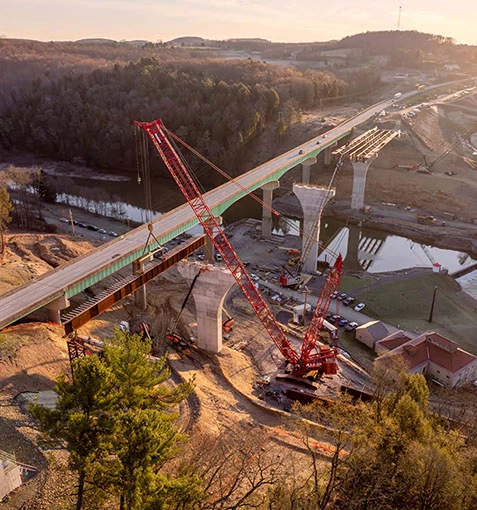
But once crawlers are assembled, they can walk on their tracks to other locations on a job site, lift major weight with their lattice booms, and hold loads for extended periods of time if needed. That combination of strength and staying power makes crawlers indispensable for major infrastructure work, energy projects, and large-scale construction.
Centralized management
Buying and selling
They remain so important to successful operations that ALL has maintained a dedicated crawler crane division for many years. ALL stalwart Chad Rados, the current director of crawler crane operations, says these mighty cranes are always in high demand. “When someone rents a crawler, it’s going to be on a job site for months, perhaps even a year or more,” said Rados.
In recent years, the stunning leaps in capacity for all-terrain cranes have stolen a lot of the crane world’s spotlight, but much like their name suggests, crawlers have been steady and consistent. They’re also a significant investment for customers, explaining why they are often chosen for longterm projects. It can take upward of 40 truckloads to deliver all their components to a site, then multiple days for assembly. ATs are roadworthy, with street-legal axles and tires, require less than half as many truckloads to carry counterweights, and can set up in less than a half-day.
But once crawlers are assembled, they can walk on their tracks to other locations on a job site, lift major weight with their lattice booms, and hold loads for extended periods of time if needed. That combination of strength and staying power makes crawlers indispensable for major infrastructure work, energy projects, and large-scale construction.
Centralized management
Behind the scenes, managing crawler cranes across ALL’s nationwide footprint melds the art and science of schedule coordination, forecasting, and real-time decision-making. Projects requiring higher-capacity crawlers are managed centrally out of ALL’s Cleveland headquarters (a strategy also being piloted for the largest all-terrain units in the fleet).
A centralized approach is key to orderly deployment. “If all the branches were trying to fulfill large crawler requests independently, we couldn’t manage it nearly as efficiently,” said Rados. The branches are still vital to the process, though. Rados receives continuous input from sales teams, general managers, and project managers across the national footprint, giving him a real-time snapshot of demand.
“Our weekly operations meetings are crucial,” said Rados. These sessions enable ALL’s branches to respond to shifting market conditions quickly. Branches share what jobs are starting, what equipment is committed, and what’s on the horizon. “Things happen much too quickly for quarterly meetings to be effective,” said Rados. “I get real-time information and make decisions about what to send where. First purchase order gets the job—but we’re always balancing that with what’s coming next.”
Keep on trucking
Reading the utilization rates
This forward-looking strategy extends into the annual planning cycle. By mid-summer, manufacturers begin asking about demand projections. By late fall, ALL is typically finalizing its “wish list” for the coming year, balancing utilization trends, fleet age, and upcoming project needs.
Major industry events like CONEXPO-CON/AGG also play a role, giving the team a chance to evaluate new models and technologies up close.
A centralized approach is key to orderly deployment. “If all the branches were trying to fulfill large crawler requests independently, we couldn’t manage it nearly as efficiently,” said Rados. The branches are still vital to the process, though. Rados receives continuous input from sales teams, general managers, and project managers across the national footprint, giving him a real-time snapshot of demand.
“Our weekly operations meetings are crucial,” said Rados. These sessions enable ALL’s branches to respond to shifting market conditions quickly. Branches share what jobs are starting, what equipment is committed, and what’s on the horizon. “Things happen much too quickly for quarterly meetings to be effective,” said Rados. “I get real-time information and make decisions about what to send where. First purchase order gets the job—but we’re always balancing that with what’s coming next.”
Keep on trucking
Once a crawler is assigned to a job, another complex process begins: getting it there. Here is where ALL having its own trucking division (famously known as “the nation’s fifth-largest trucking company … if it were a trucking company”) sets it apart. With local trucking fleets as well as major logistics hubs in Cleveland, Nitro, W. VA, and Wisconsin, ALL coordinates hundreds of components and untold dozens of truckloads for a single crane move.
Rados works closely with ALL’s trucking division to map out each shipment down to specific configuration and parts. Hubs coordinate to avoid inefficiencies such as trucks crossing paths unnecessarily.
On especially large moves, national trucking resources are supplemented by local branch support. “We’re not going to ask a branch to handle 20-plus loads,” said Rados. “But they might take a few to help the process along.”
To further streamline logistics, ALL has implemented a parts tracking system. Thousands of crane components are in the process of being tagged with small sensors, giving teams quick access to locations of parts and more easily steer them to the appropriate branch.
Rados works closely with ALL’s trucking division to map out each shipment down to specific configuration and parts. Hubs coordinate to avoid inefficiencies such as trucks crossing paths unnecessarily.
On especially large moves, national trucking resources are supplemented by local branch support. “We’re not going to ask a branch to handle 20-plus loads,” said Rados. “But they might take a few to help the process along.”
To further streamline logistics, ALL has implemented a parts tracking system. Thousands of crane components are in the process of being tagged with small sensors, giving teams quick access to locations of parts and more easily steer them to the appropriate branch.
Reading the utilization rates
Crawler cranes may not generate the same buzz as ATs, but their utilization rates tell a powerful story. Because crawlers are typically tied to long-term projects, shifts in demand become clear very quickly.
At the start of this year, for example, ALL’s 200-ton class crawlers were immediately booked into long-term work. “That tells us right away those machines are hot,” said Rados. “It’s a signal we may need to invest more in that class.”
Meanwhile, demand for the 330-ton class has been especially strong, driven largely by data center construction and bridge work, two sectors that continue to expand nationwide. Taking note of these patterns can drive deployment decisions as well as contribute to long-term purchasing strategy.
“It’s all about gathering data,” said Rados. “That’s what allows us to sit down and talk about what we need for the rest of the year and beyond.”
One of the biggest challenges facing the crawler market today is manufacturer inventory. Demand is high, and getting a crane off the production lines is much more time-consuming than an automaker pumping out SUVs.
ALL takes a proactive approach, working closely with manufacturers to anticipate market needs. Strong relationships with crane makers allow Rados to understand what models will be available—and when—and factor potential purchases into current job planning.
“Because of the communication we have with manufacturers, we’re able to plan months ahead with a clear understanding of what new cranes are coming, where they’ll be needed, and when they’ll be available,” he said.At the start of this year, for example, ALL’s 200-ton class crawlers were immediately booked into long-term work. “That tells us right away those machines are hot,” said Rados. “It’s a signal we may need to invest more in that class.”
Meanwhile, demand for the 330-ton class has been especially strong, driven largely by data center construction and bridge work, two sectors that continue to expand nationwide. Taking note of these patterns can drive deployment decisions as well as contribute to long-term purchasing strategy.
“It’s all about gathering data,” said Rados. “That’s what allows us to sit down and talk about what we need for the rest of the year and beyond.”
One of the biggest challenges facing the crawler market today is manufacturer inventory. Demand is high, and getting a crane off the production lines is much more time-consuming than an automaker pumping out SUVs.
ALL takes a proactive approach, working closely with manufacturers to anticipate market needs. Strong relationships with crane makers allow Rados to understand what models will be available—and when—and factor potential purchases into current job planning.
This forward-looking strategy extends into the annual planning cycle. By mid-summer, manufacturers begin asking about demand projections. By late fall, ALL is typically finalizing its “wish list” for the coming year, balancing utilization trends, fleet age, and upcoming project needs.
Major industry events like CONEXPO-CON/AGG also play a role, giving the team a chance to evaluate new models and technologies up close.
Buying and selling
Fleet strategy isn’t just about buying new cranes. It’s also about deciding what to keep, rebuild, or sell. These decisions are influenced by multiple factors: machine age, resale opportunities, and evolving customer requirements. For instance, recent sales of several large crawlers prompted a reassessment of replacement needs, ensuring the fleet remains modern and competitive. ALL’s facility in Nitro, West Virginia, plays a key role here, taking cranes offline for partial rebuilds that can include track replacements, structural updates, and fresh paint.
Crawler cranes remain the quiet workhorses of the industry, delivering continuous performance through long-term projects and anchoring some of the most demanding jobs in construction.
Through a combination of real-time data, nationwide coordination, and long-standing industry relationships, ALL ensures that these complex machines are not only utilized efficiently, but positioned exactly where they’re needed most. It’s a strategy built on experience, communication, and a deep understanding of the signals that drive the crawler crane market.
“I couldn’t imagine having a fleet without crawlers,” Rados said.
Crawler cranes remain the quiet workhorses of the industry, delivering continuous performance through long-term projects and anchoring some of the most demanding jobs in construction.
Through a combination of real-time data, nationwide coordination, and long-standing industry relationships, ALL ensures that these complex machines are not only utilized efficiently, but positioned exactly where they’re needed most. It’s a strategy built on experience, communication, and a deep understanding of the signals that drive the crawler crane market.
“I couldn’t imagine having a fleet without crawlers,” Rados said.

