
Featured in Lift Line Winter 2026
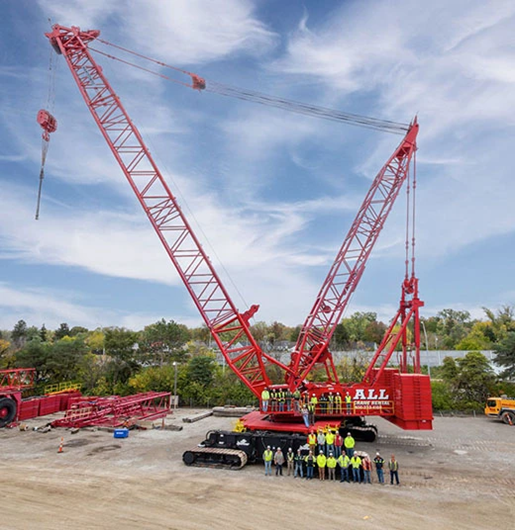
The mighty Manitowoc 21000—with its 1,000 ton capacity, 400-foot boom, and landmark Octa-trac®—revolutionized the crawler crane category more than a quarter-century ago. Now, with ALL’s last 21000 preparing to leave U.S. shores for a South American retirement, we’re taking a look back at the remarkable impact of this heavy-lift titan.
Previous millennium debut
When it debuted in 1999, the Manitowoc 21000 was the star of the show at ConExpo. It represented a major milestone in the heavy lift industry, both technologically and operationally. It was one of the largest capacity crawler cranes ever produced at the time and marked Manitowoc’s entry into the “super heavy lift” class, a step beyond the already powerful 4100 and 888 models. Its capacity allowed contractors to take on projects previously requiring multiple cranes or more complex lift strategies.
“When it debuted, the 21000 was the perfect industrial heavy lift crane,” said Chad Rados, ALL’s director of crawler operations. “It was huge, but with a smaller footprint than the large cranes that came before it. It could get closer to an industrial lift zone, then had the long boom and high capacity to reach over potential obstructions. It simplified the execution of lifts that might have been more problematic in the pre-21000 era.”
Eight tracks, not two
The Octa-trac® system was one of the most distinctive and significant engineering features of the 21000, and it played a major role in why the crane was such a breakthrough. Instead of two long crawler tracks, it had a pair of short tracks in each corner – eight in total. This spread the load, reduced ground pressure and need for extensive mats, and let the crane be more compact than a 1,000-ton machine otherwise might be.
“We purchased our first 21000s for heavy lifts in industrial settings, steel mills, and refineries,” said Rados. “They put us in a great position to attract more work in those markets. We knew we could cover the majority of jobs because we had such a wide range of crawlers, all the way up to the 21000. Locally we were the only company with that size crane.”
It's how big?
To put the staggering size of the 21000 in proper context, over the years we’ve compared it to colossal totems both real and fictional. An article from 2015 discussed how the 21000 stacked up to Japan’s infamous silver screen reptile, Godzilla. We wrote at the time: “In the original 1954 film, Godzilla stood about 164 feet tall. His height was such that he could just peer over the largest buildings in Tokyo at the time. In the latest American version of the film, released in 2014, Godzilla is said to be over 400 feet tall. We presume this was to make him as tall as the Manitowoc 21000 with long-reach boom. Add the luffing jib extension, and the 21000 reaches to 640 feet.”
In this same article, we noted that the crane is more than double the size of the Statue of Liberty, which stands 300 feet tall.
Notable jobs
Richard Randall, general manager of ALL Crane Rental Corp. of Columbus, was a young sales rep at ALL’s Cleveland headquarters when the 21000 debuted. He recalls an early job when the crane was tasked with helping to dismantle the decommissioned Hulett iron ore unloaders from the shores of Lake Erie. Huletts were massive, 10-story electric cranes that were staples at cargo docks prior to the advent of self-unloading ships.
He recalls another instance when members of the U.S. military came to the Cleveland yard to watch a demonstration of the 21000 operating a new mechanism intended to lift intercontinental ballistic missiles (ICBMs). “It needed to lift a million pounds,” said Randall.
In recent years, Randall’s branch has used 21000s in the construction of data centers that are popping up all over the Midwest, massive climate-controlled server farms for tech companies like Google and Meta, and e-tailers like Amazon. “I tell my guys, you’ve got to see one of these up close. It’s a part of history. It represents perhaps the first generation of mega-capacity cranes, yet it uses technology from what is now the previous generation.”
The power of the 21000 was called upon to assist at NASA’s Kennedy Space Center, helping to construct a mobile launch tower for the Ares I spacecraft. It lifted 300ton expansion modules at a Toledo oil refinery. Perhaps its most humbling service was aiding with recovery operations in New York City following the Sept. 11 terror attacks. It was delivered to Ground Zero, where it performed the solemn task of processing rubble of the World Trade Center towers.
What crane next
Nothing lasts forever, though. Not even the reign a 1,000-ton crawler. “Now, the Manitowoc MLC650 with VPC-MAX has taken over much of the work that used to go to the 21000,” said Rados. He cites the MLC650’s smaller footprint and less required ground prep as reasons for its emergence.
It’s a sentiment shared by Kevin Blaney, Manitowoc’s vice president of sales for crawler cranes and direct accounts. “Where the 21000 opened the door for large, powerful cranes, these days it’s about versatile attachments and stronger booms that enable cranes well under 1,000 tons to perform the same kinds of lifts,” said Blaney. “Our new six-meter boom for the MLC650 will compete with a 1,000-ton machine.”
Blaney says the name of the game today is offering the highest capacities possible with a smaller footprint, delivering the crane to the job site in fewer loads, and exerting less ground bearing pressure once there.
“Starting with a smaller base and offering a wider variety of attachments also creates more transport options. By configuring a crane with exactly what it needs to perform a specific function—and only that function—it helps keep transport costs down.”
Bound for Peru
So, ALL’s final 21000 is headed to a crane rental operation in Peru. It’s a testament to the longevity and reliability of the Manitowoc product that there is still a market globally for this mighty crawler.
Rados says at least some of the credit also belongs to ALL’s service teams. “It’s also a testament to our service department, especially in Nitro, W. Va., that there is still a market for this machine. They’ve kept it in top condition. The technology might be a quarter-century old, but the machine itself still performs almost like new.