Featured in Lift Line Winter 2026
What happens when planning meets precision? In this completed project spotlight, we return to the jobsite where a challenging lift has now turned into finished infrastructure.
The accompanying video features an in-depth Q&A with the ALL lift planner, Brian Meek, who helped orchestrate the operation— from site challenges to crane configuration and crew coordination. The result was a safe, efficient lift that overcame narrow access, changing terrain, and long radii.
This follow-up article provides background on the job, including the equipment involved, the project’s goals, and how the lift unfolded in real time. The full video interview offers even more insight—capturing the perspective of the planner in their own words, with visuals of the site before, during, and after the lift.
Project Overview
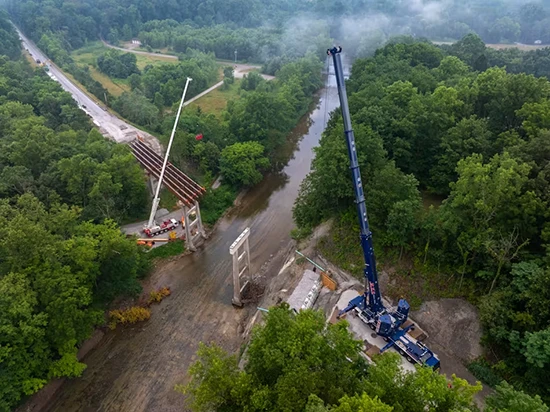
The State Route 6 bridge over the Chagrin River in Lake County, Ohio, had reached a point where continued repairs were no longer practical. With its aging structure spanning an 80-foot drop through thick forest, the decision was made to fully demolish and rebuild the bridge.
ALL Erection & Crane Rental, flagship branch of the ALL Family of Companies, partnered with general contractor the Ruhlin Company to plan and execute both phases of the work: demolition of the old bridge and construction of the replacement. The job required precision lifts of steel beams ranging from 15,000 to 28,000 pounds at long radii, along with critical support during beam removal. The project took place in two phases: demolition in the spring and construction in midsummer. The bridge is now open to traffic.
Equipment Summary
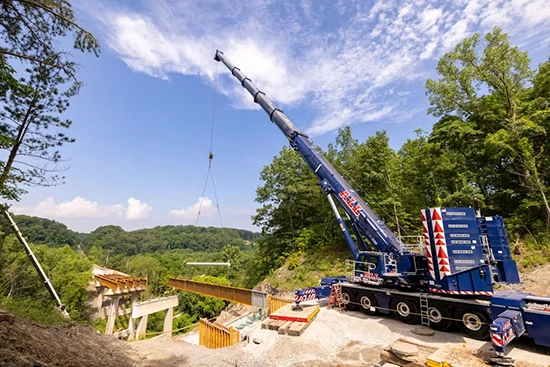
To perform the work, ALL specified a 770-ton Liebherr LTM 1650-8.1 all-terrain crane, known as the “Blue Beast” for its distinctive cobalt-blue finish. The crane operated at a lift radius of 215 feet with boom lengths ranging from 246 to 262 feet, and carried 319,000 pounds of counterweight. Its size, reach, and mobility made it ideal for the complex demands of this bridge project.
For support, a 120-ton Liebherr LTM 1100-5.2 AT was used as an assist crane, positioned on the narrow riverbank below the bridge. It provided both man basket access during demolition and hoisting support during beam placement. At times, the two cranes worked in tandem to achieve extended reach and lift coverage across the full bridge span.
Project Challenges
Site access posed significant hurdles. The approach to the bridge featured a 5% roadway grade, which is unusually steep for heavy equipment. Additionally, the bridge was bordered by dense forest and sheer drop-offs, leaving little room for crane setup—especially on the west side.
To overcome these conditions, ALL provided ground bearing pressure data and lift diagrams, which Ruhlin used to engineer specialized crane pads. These were constructed using stone and timber mats to safely support the crane’s weight. On the restricted west side, ALL leveraged Liebherr’s VarioBase® technology to minimize outrigger spread and safely swing the boom over the rear of the crane, reducing the overall footprint.
During demolition, the height of the bridge made aerial lifts impossible. The assist crane was outfitted with a man basket, allowing crews to access beams while the 1650 held them in place from above. For new beam installation, the two cranes sometimes operated in tandem, with the 1650 delivering beams over the piers and the 1100 taking the handoff to complete the placement at extended reach.
These coordinated efforts—both in planning and execution—ensured the project stayed on schedule, performed safely, and met every challenge presented by the terrain and structure.