In Columbus, Ohio, there are sure signs of winter. Days get shorter, temperatures drop, Ohio State basketball starts replacing football on television. And at the intersection of Gay and High Streets, “Current” comes down.
The 229-foot, vibrantly colored, floating fiber sculpture is normally suspended more than 100 feet in the air. Assembled from a half-million knots in 78 miles of twine, the net, created by artist Janet Echelman, retires for the cold season because winter moisture can become trapped and form ice, which can dangerously fall back to the ground during thaws.
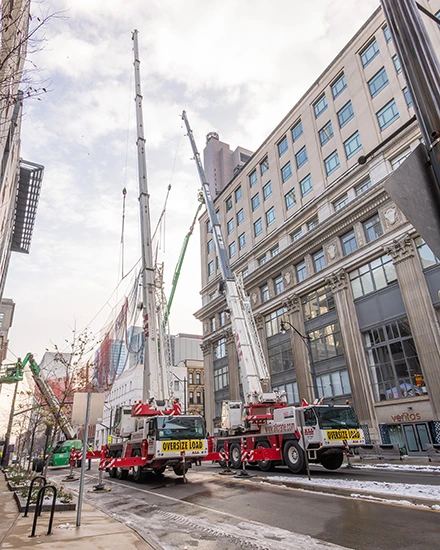
So, each year in early December, an impressive crew of contractors and equipment assembles to conduct the delicate work of removing “Current” from its four anchor points, carefully gathering it up, and securely placing it in storage until the spring.
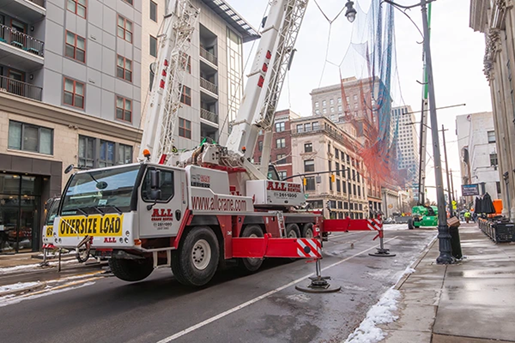
ALL Crane Rental Corp. of Columbus, a member of the ALL Family of Companies, provides the cranes needed to uncouple the sculpture from its anchor points, embedded into the exterior walls of buildings lining the street. Atlas Industrial Contracting spearheads the initiative, bringing four of its own man baskets and several forklifts to assist with baling. In all, more than a half-dozen pieces of equipment and 15-20 people are involved in the undertaking.
Because the sculpture is primarily a net-like material, capacity isn’t the primary objective from a crane standpoint. It’s reach and mobility.
“The protocol we’ve developed is that it’s better for the two cranes to first remove one end of the sculpture then move to the opposite end and detach the final two connection points,” said Bill Hanners.
This need for mobility is why two all-terrain cranes are specified for the job. This year, it was a 50-ton Liebherr LTM 1060-3.1 and a 110-ton Liebherr 1090-4.2. In years past, two 1060s have done the job. “Both cranes were configured with approximately 140 feet of main boom,” said Hanners.
Crew members from Atlas, carried in man baskets, rig each crane to the appropriate connection point on the art piece. Cranes gently lower the first end downward so crews on the ground can remove the sculpture from the rigging and begin the folding process. Then the cranes drive to the other end and repeat the process.
“This is always done on a Sunday afternoon,” said Hanners. “This is a busy corridor in downtown Columbus. Sunday is the least-intrusive time to have Gay and High Streets closed for several hours.”
Hanners notes that, after several years of doing this, the team can complete the operation in three or four hours.
After “Current” is folded and placed in its special protective container, it goes into storage for the winter.
Then, in a few months will come a sure sign of spring in Columbus. Each March or April, ALL and Atlas return to the intersection of Gay and High Streets to re-install the brightly colored fiber sculpture, as the gray skies of winter give way to blue.